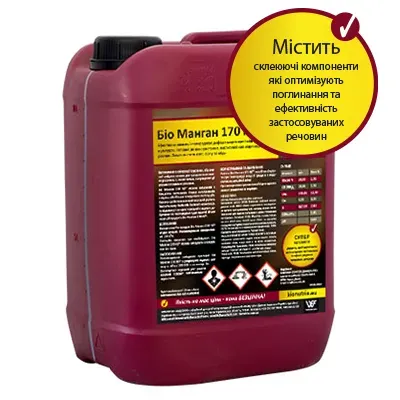
A product with a high content of manganese Mn and cobber Cu, ready to use, with the addition of an adhesive component. Also contains nitrogen N and sulfur S. Intended for foliar feeding of all crops.
Action
- Quickly absorbed. Eliminates the deficiency of trace elements of manganese and sulfur.
- Relieves stress from the impact of agrochemical agents.
- Regulates chlorophyll, photosynthesis, carbohydrate, protein, water metabolism and concentration of growth substances - auxins.
- Enhances stress resistance of plants to weather conditions and fungi.
- Increases moisture-containing ability.
1-3 l/ha
50-200 l of water/ha
1-2 applications
Easily mixed with other pesticides and microfertilizers
Product based on SO4 sulfates
Adjust the pH of the working solution
A small molecule that penetrates the cuticle
Contains adjuvants and bonding agents
Simple and safe to use
They are stable, do not delaminate, do not crystallize and do not precipitate even after long-term storage
Regulates photosynthesis
Increases the content of chlorophyll in the leaves
It is related to the efficiency of the plant's use of N nitrogen
Product composition
| N | CO(NH2)2 | S | Mn | Cu | Density | pH | |
| g/l | 24,31 | 24,31 | 106,25 | 170 | 4,29 | ||
| % | 1,70 | 1,70 | 7,43 | 12,3 | 0,30 | 1,45 | 4,53 |
Application
- Foliar feeding is carried out on vegetative plants, together with protection products after a compatibility test.
- The working solution is prepared before application.
- Fertilization is carried out according to development phases early in the morning or in the evening, avoiding bright sun, rain and strong wind, at an average daily temperature not lower than + 5oC.
Mixing order
- Water
- Bio pH Control
- Bio Crop Opti
- Bio Mangan
- Pesticides
- Bio Bor 150
Recommendations
|
CROP |
APPLICATION PHASE |
DOSAGE l/ha* |
|
Wheat/Barley |
3 leaves tillering 2nd node is determined Visible ligula of a flag leaf |
1 1 1 1 |
|
Corn |
3-4 leaves 7-10 leaves repeated |
1 1 1 |
|
Soybeans |
2-3 leaves 4-5 leaves |
1 1-2 |
|
Canola |
3-5 leaves 7-10 leaves Stem growth Budding |
1 1 1 1 |
|
Sunflower |
5-7 leaves repeated |
1 1 |
|
Sugar beet |
4 leaves 9 leaves Beginning of crop closing |
1 1 2 |
|
Potato |
3 weeks after sprouting Repeated application |
1,5 1,5 |
* recommended volume of water: 50-200 l/ha
Detailed crop application plan is on the LINK